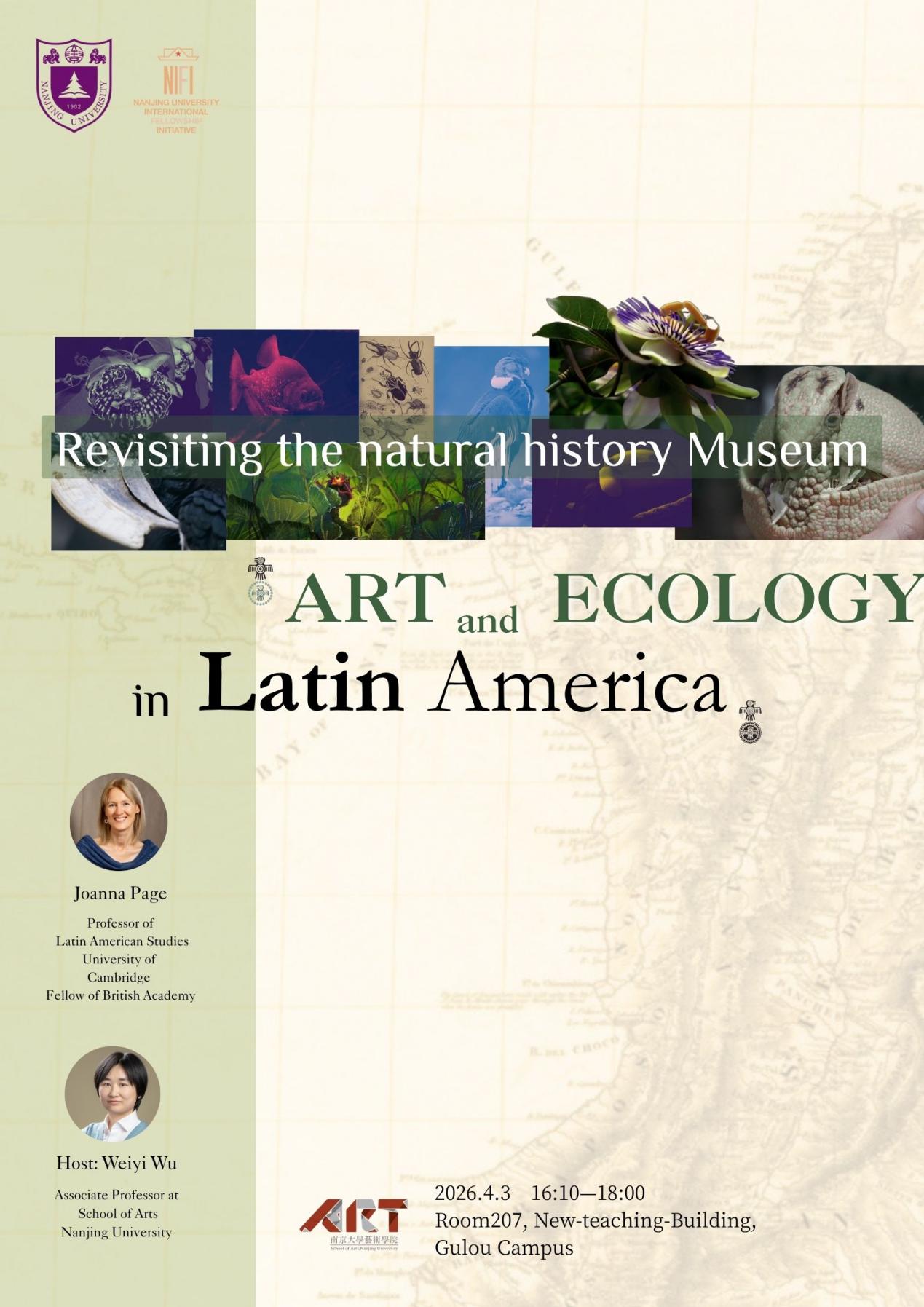
Title: Bioart, Ecology and the Ethics of ‘Slow Science’: Perspectives from Latin America
Time: April 1, 2026, 19:00-20:30
Venue: Room 310, East Building, School of Arts, Gulou Campus, Nanjing University
Speaker: Joanna Page, Professor of Latin America Studies at the University of Cambridge, Director of the Centre of Arts, Social Sciences and Humanities (CRASSH), Fellow of British Academy.
Host: Wu Weiyi, Tenure-track Associate Professor at the School of Arts, Nanjing University.
Content Summary:
This lecture will draw on examples from recent Latin American art (by Ana Laura Cantera, Gilberto Esparza, Ivan Henriques, the Interspecifics collective and others) to argue that contemporary art-science projects play a very powerful role in reconnecting science with the world beyond the laboratory. These artists do not primarily engage with scientific practices in order to critique them but to expand them and reconnect them with spheres of knowledge that have systematically been excluded from modern Western science.
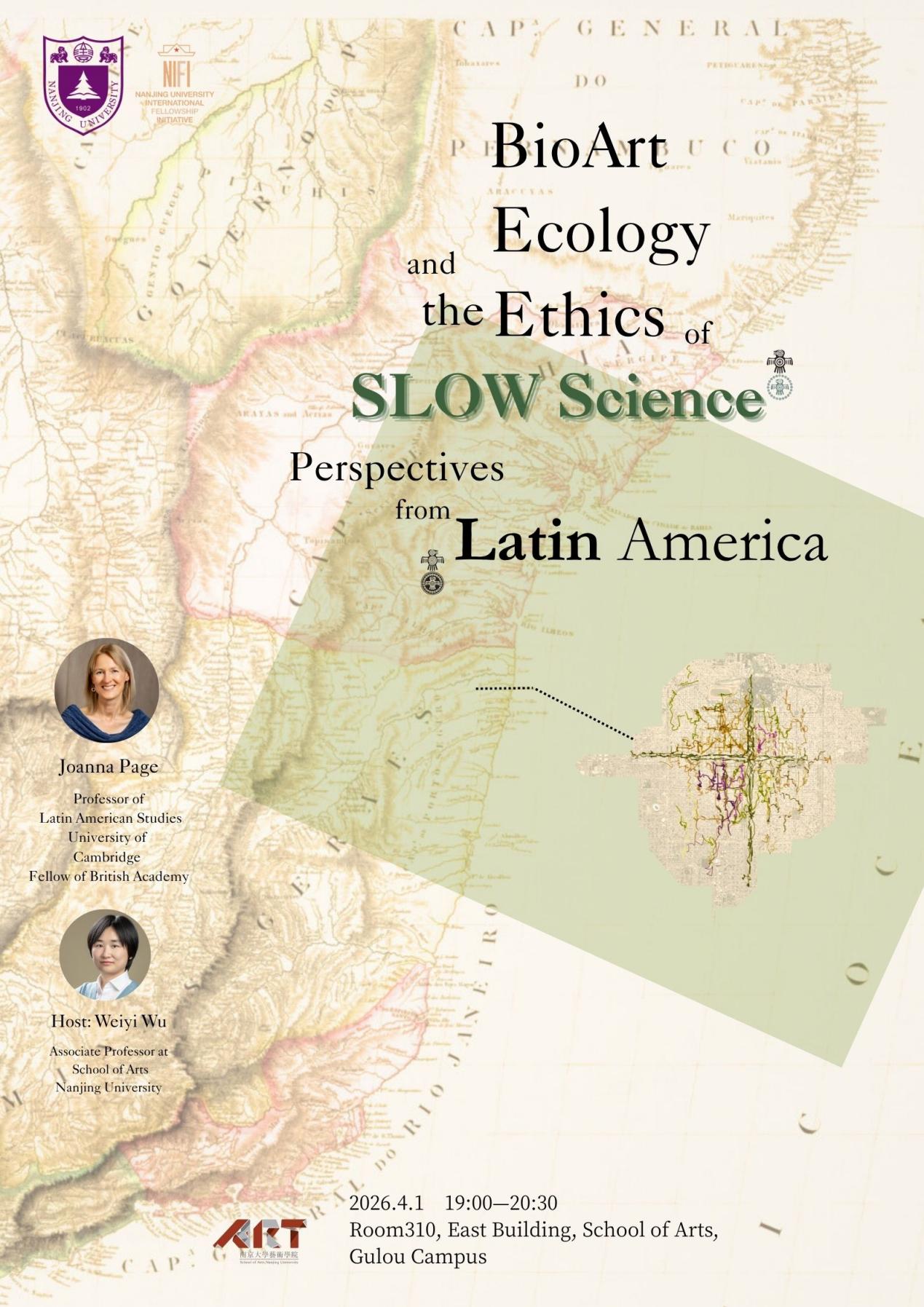
Title: Revisiting the Natural History Museum: Art and Ecology in Latin America
Time: April 3, 2026, 16:10-18:00
Venue: Room 207, New Teaching Building, Gulou Campus, Nanjing University
Speaker: Joanna Page, Professor of Latin America Studies at the University of Cambridge, Director of the Centre of Arts, Social Sciences and Humanities (CRASSH), Fellow of British Academy.
Host: Wu Weiyi, Tenure-track Associate Professor at the School of Arts, Nanjing University.
Content Summary:
This lecture examines how contemporary Latin American artists critically reconfigure the visual and epistemic conventions of the Natural History Museum, particularly its specimen cabinets, taxidermy, and dioramas. Focusing on the work of Cristian Villavicencio, Daniel Malva, Walmor Corrêa, Rodrigo Arteaga, and Pablo La Padula, it explores how these artists unsettle the museum’s role in reproducing a European, colonial divide between nature and culture. Drawing on historical display techniques, they rethink human-nonhuman relations in the context of ecological crisis and decolonial critique.